What really happened (to us) at COP26(RUDOLPH Sven /2022)
Name
RUDOLPH Sven
Department
第9期 特定准教授(地球環境学堂)
Research Field
Climate policy, Carbon pricing

Term
2021.10.26-11.17
Destination
イギリス(スコットランド)・グラスゴー
Purpose
学会
Results
★★★★★
今回の渡航目的
“No more blah, blah, blah,” is what youth climate activist Greta Thunberg demanded of world leaders ahead of COP26, the 2021 United Nations Climate Conference ( 国連気候変動枠組条約第26回締約国会議). Accredited by Kyoto University, my doctoral student and I travelled to the UK in November 2021 to investigate whether this call was being heard – particularly with respect to Article 6 of the Paris Agreement on international emissions trading.
グラスゴーってどんなとこ?
COP26 was held in Glasgow – an old industrial city on the River Clyde, which was designated as European Capital of Culture in 1990 and is the gateway to Scotland’s Western Highlands and islands. In the 18th century, Glasgow was a hub of the Scottish Enlightenment and home to Adam Smith, the founding father of modern economics.
発見と成果
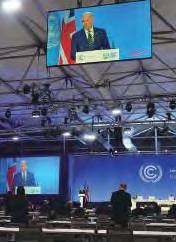
During our visit to COP26, we watched head of states set the scene at the World Leaders Summit; scientists conduct the
groundwork in the first week; and national negotiators appear on stage in week two to finalize the Glasgow Climate Pact. And indeed, we learned a lot about the stumbling blocks of international climate negotiations.
We had also come to COP26 to conduct stakeholder and expert interviews on the prospects of linking domestic emissions trading schemes (ETS). Unfortunately, however, COVID-19 restrictions limited our opportunities to do so. But still, in elevator pitch-style interviews during negotiation breaks, we gathered crucial data and – more importantly – established a wide international network of high-ranking government officials for indepth follow-up online interviews. The data supported our hypothesis that international ETS linking is mainly impeded by a lack of political will and distrust among potential partners, rather than by technical design barriers. The results have since been presented at several international conferences and published in the highly ranked journal Environmental Politics in 2022.

ちょっと一息
Often, rather than the main events and meetings, it is the unexpected encounters and experiences off the beaten track that make research abroad particularly stimulating and worthwhile: seeing schoolgirls demand that politicians “save our penguins”; watching artists from low-lying island states most impacted by global warming remind the global community of their responsibilities; or discussing the regional impacts of global warming with locals over a portion of traditional fish and chips.