How do we study the evolution of the mind:The evolving methods (GAO Jie/2024)
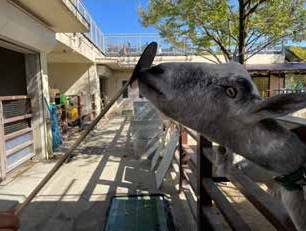
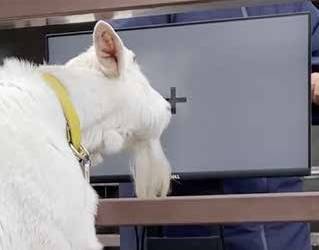
All these reasons made me decide to continue the touchscreen methods in my new projects with domestic goats. I started this project because land mammals are important in evolution, but their cognition is rarely studied. Studying a domestic species could also help understand the effect of domestication on the animal minds. I have trained several goats to use the touchscreen, by step-by-step conditioning. First, I used a stick and a plastic plate and trained them to touch the plate to get a piece of carrot( Fig. 2). Then, I used a white board and a magnet shape and trained them to touch the shape on the board. And finally, we transferred to the touchscreen (Fig. 3). They just completed a pilot test in shape discrimination.
Many other methods are rising, too, apart from touchscreen tasks. I used an eye-tracker, which tracks eye gazes, to complete an experiment to know if chimpanzees look at the strange body parts in search for their body perception. Self-assembled machines could be adopted, too. For example, in a study finding the strategy pigeons use in flying, researchers let pigeons wear light backpacks containing sensors. If this is ever needed, I will plan to adopt new technology for the goats, too. How cool it is for goats to have backpacks collecting research data.
References
- Kellogg, W. N., & Kellogg, L. A.( 1933). The Ape and The Child: A Comparative Study of the Environmental Influence Upon Early Behavior. Hafner Publishing Co., New York and London
- Chen, T., Gao, J., Tan, J., Tao, R., & Su, Y.( 2017). Variation in gaze-following between two Asian colobine monkeys. Primates, 58, 525-534.
- Tan, J., Ariely, D., & Hare, B. (2017). Bonobos respond prosocially toward members of other groups. Scientific reports , 7(1), 14733.
- Gao, J., Su, Y., Tomonaga, M., & Matsuzawa, T. (2018). Learning the rules of the rock–paper–scissors game: chimpanzees versus children. Primates , 59, 7-17.
- Gao, J., Adachi, I., & Tomonaga, M. (2022). Chimpanzees (Pan troglodytes) detect strange body parts: an eye-tracking study. Animal Cognition, 25 (4), 807-819.
- Kano, F., Naik, H., Keskin, G., Couzin, I. D., & Nagy, M. (2022). Head-tracking of freely-behaving pigeons in a motion-capture system reveals the selective use of visual field regions. Scientific Reports , 12 (1), 19113.