How do we study the evolution of the mind:The evolving methods (GAO Jie/2024)
The probably most adopted method is what I would like to call, the object-based paradigm, or the faceto-face paradigm, not literally though: researchers design a task, and conduct it manually, sometimes face-to-face with the animals. When I did my very first experiment in this field, I did a gaze following test with François’ langurs, a species of monkeys. The test is as follows. I sat on a chair in front of the test monkey’s room so that I was close to the monkey and my eyes were about the same level as the monkeys’. Then, I grabbed their attention by bringing up a peanut, their favorite food. Then, when they were looking at me, I moved my head and stared at the sky for 10 seconds. All of these are recorded, and we “coded” whether the monkey followed my gaze or not by checking the video. Gaze following is an important ability, because it can help animals pay attention to what others are looking at: a predator, a food, or a social member. It’s also regarded as one of the basic abilities of empathy. In this experiment, I did the task face-to-face with the animals. Another example comes from a project in bonobos, close relatives to chimpanzees and then humans, showing how pro-social they are: they share food with strangers! It may not sound surprising to humans who are not comparative psychologist, but for us, it is very surprising: I have seen captive chimpanzee mothers don’t even share food with their children. In this experiment, researchers manipulated the door so the bonobos can choose to open or not open it for the stranger bonobos. This method was also object-based. Although not strictly face-to-face with the animals, there is no other technology involved.
After my first project in monkeys, I joined the team at Kyoto University to study chimpanzees. The chimpanzees there were trained to use touchscreens, and most of my studies were done using touchscreens. There are several advantages to use touchscreens. First, it is more well-controlled. In the object-based paradigm, there could be many conscious or nonconscious biases. For example, in the gaze-following experiment, it was possible that I cannot fix my head angle exactly the same for every test. For the bonobo experiment, it was possible that the stranger bonobos appeared a bit earlier or later, different in each test, causing a possible minor effect to the results. If we use a computer task on a touchscreen, like we do with human participants in many psychology experiments, the appearance and duration of the stimuli images and videos could be strictly controlled. Secondly, using touchscreens enables a more accurate recording of the results. In the face-to-face tests, confirming animals’ choices can be tricky sometimes. However, because they need to touch the screen to make responses in touchscreen tasks, this problem could be solved. Also, response time could be recorded by the test program in the computer. In face-to-face experiments, if one wants to acquire response time data, one needs to play back the experiment video, set marks on the video, and calculate the duration for each test trial. Third, the use of computer frees the hands in terms of preparing and showing stimuli materials. My previous supervisor told me that he had to take photos, print the photos, cut the photos, and paste the photos, to prepare the test photos, and during the experiment, exchange them a lot, in his youth for conducting experiment. Now, with the help of computer, we could just take the photos, and edit them, and then use programming, so they could appear automatically in the tests. My first study using the touchscreen was to test if chimpanzees could learn the rule of the rock-paper-scissors game. Every test trial had two photos, and they needed to choose the stronger one to get food rewards (Fig. 1). Every test session had 48 trials. Imagine all the photo switching if I had to do it in a face-to-face manner!
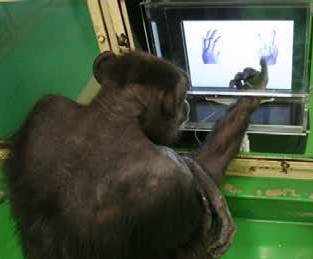
on a touchscreen